


Kaleidoscope Mania:
19th Century Optical Toys


Tis a tube made of brass, pewter, copper, or tin,
With a hole at one end of it where you look in,
And see – gracious heavens! – you see such a sight,
Should I try to describe it ’twould take me all night;
The exquisite figures and colours you can see,
No painter can copy, no poet can fancy:
You see – what must all you’ve before seen surpass
You see – some small old broken pieces of glass!
Need I tell you, indeed, that with such preparation,
So lovely a bauble has caused a Sensation?
- from 'The Caleidoscope and the Tetrascope’, The Literary Journal (17 May 1818), p. 122.
Introduction
_edited.png)
What exactly was this device that ignited a mania? The kaleidoscope was a lovely mix of science, aesthetics, and entertainment. This philosophical toy - an object that demonstrated a scientific phenomenon while also providing amusement - was the
first of many that would become popular in the 19th century. The kaleidoscope was a relatively simple device, yet it was something totally
new. Over two centuries later, the intricate shapes and brilliant colors are still appreciated, but upon its invention, all of Regency London was consumed with kaleidoscope-mania. How did it come to be and what followed in its footsteps?
Sir David Brewster was no toy maker. He was a serious scientist, who largely concerned himself with optics. As such, the kaleidoscope was the result of Brewster's studies on light polarization. He wrote, "On the 7th of February 1815, when I discovered the developement of the complementary colours , by the successive reflections of polarised light between two plates of gold and silver , the effects of the Kaleidoscope, though rudely exhibited were forced upon my notice..." The bits and pieces were reflected by mirrors or glass lenses fixed at positions, and the result was a symmetrical mosaic pattern seen through the end of the tube. With a slight turn of the tube, something new and beautiful appeared. Brewster named the invention using the Greek words, kalos, which means beautiful, eidos, which means form, and scopos, which means watcher.

from Caleidescope-mania - or the Natives astonished, Anonymous, 1817-1820.
The Mania

Young and old, rich and poor, everyone wanted a kaleidoscope in the years following its invention. David Brewster wrote in a letter, “You can have no conception of the effect which the instrument excited in London; all that you have heard falls infinitely short of the reality. No book and no instrument in the memory of man ever produced such a singular effect.” In his A Treatise on the Kaleidoscope, he described the excitement as being so sensational that you would have had to have seen it to believe it and that there were at least 200,000 kaleidoscopes sold in London and Paris within the first three months.
Plate XV, Encyclopaedia londinensis, or, Universal dictionary of arts, sciences, and literature v.17 (1820).
And it does seem that it was the first time in history that a fad had spread so quickly and thoroughly through lands both near and far. Brewster's daughter penned a biography of her father, and with regard to the kaleidoscope she declared that “with its marvellous witcheries of light and colour, spread over Europe and America with a furor which is now scarcely credible’’. Many sources support this claim. Thus, one might think that Sir David Brewster became a very rich man as a result. However, his patent was unable to protect his invention and prevent other makers from selling their own versions. The varying quality may have irked Brewster even more than the loss of profit.

Perhaps the inability of the patent to protect Brewster's invention is what allowed it to spread so far so quickly. For example, while in Italy in late 1818, Percy Bysshe Shelley wrote to fellow poet James Hogg, “Your Kalleidoscopes [sic] spread like the pestilence at Livorno…I heard that the whole population were given up to Kalleidoscopism.” Furthermore, no later than June of 1818, advertisements were appearing in American newspapers and were reporting on the popularity of the kaleidoscope. The Rhode-Island American and general advertiser relayed in the "Foreign News" of September 8, 1818 that "Letters from Constantinople announce, that the kaleidoscopes have penetrated those ancient walls, and constitute the amusement of the beautiful captives of the Seraglio."
The Spread of Philosophical Toys
from Eric Faden, Thaumatrope (Magic Circle), 2011, Bucknell University.
Thaumatrope
John Ayrton Paris introduced the thaumatrope in 1825. The simple device used a circular card with images on both sides, and using two strings attached to it, the card would spin and produce an optical illusion. The images on different sides of the card strike the eye as one. This was another philosophical toy that spread very quickly. An article was written in the Cincinnati Literary Gazette in July of 1825, that described as a "A curious toy, on revolutionary principles, which bids fair to turn the whole world topsy-turvy..."

Phenakistoscope, manufactured by Alphonse Girou, after 1834, France, Museu del Cinema.
Phenakistoscope
The Phenakistoscope was invented in 1833 by Belgian physicist Joseph Plateau, and was perhaps, the first true animation device. As far back as Ptolemy, scientists had written about the phenomenon of persistence of vision, a principle that the phenakistoscope relied upon. Likewise, Sir David Brewster wrote in his 1831 treatise about the illusion of a complete circle of light created when a burning stick is whirled in a circle. The phenakistoscope created animation in this way. The disks held a series of drawings on one side which were separated by slits. When it was held before a mirror and rotated, and viewed through the slits, the drawings appeared to move...an early motion picture.


Wooden stereoscope, 1890's, Liljenquist Family Collection, National Museum of African American History & Culture.
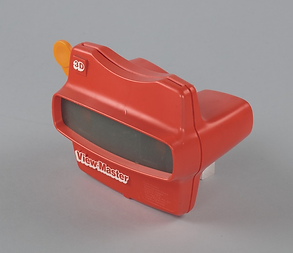
Mattel View-Master owned by Michael Holman, c.1984, National Museum of African American History & Culture.
Stereoscope
Turning pictures on cards into three dimensional scenes, the stereoscope was the original VR. It was invented by Charles Wheatstone in 1832. Whereas the phenakistoscope utilized differing hand-drawn images, the stereoscope used two identical side-by-side images and relied on photography. When viewed through a stereoscope, the two photographs appear as a single 3-D image. Sir David Brewster, the inventor of the kaleidoscope, debuted his lenticular stereoscope at the Great Exhibition of 1851 in England. David Brewster improved the device by adding refractive lenses to his model (replacing the mirrors with prisms), making it ready for use by the general public. To further improve access to the stereoscope, Oliver Wendell Holmes developed a hand-held version in 1861.
The most common subjects of the stereographs were architectural forms and landscapes, but also included photos of current events. For example, images of the American Civil War were widely distributed. However, dramatically posed scenes were also popular, especially ones that illustrated love and courtship or any scene to excite or amuse. Thus, the lure of the stereoscope continued despite the onslaught of technological amusements to come. In the form of Mattel's View-Master, it persisted as an object of amusement even in the late 20th century.

The Ghost in the Stereoscope, London Stereoscopic and Photographic Company, ca. 1856, Metropolitan Museum of Art.
Seeing the Future
It was the study of optics that led to each of these philosophical toys, but the kaleidoscope was different from these later inventions with its abstract forms and randomness. Through the magic of the kaleidoscope, Brewster hoped to illuminate the relationship between "scattered intensities" and demonstrate a "magical union of parts". The popularity of the kaleidoscope was at the forefront of a trend in optical advancements. Furthermore, it represented a new consumer culture, whereby the kaleidoscope created a mania that could be fed by quick production, growing capitalism, and a public with money in their pockets.

from Caleidoscopes or paying for peeping, Charles Williams, 1818.
Brewster calculated his kaleidoscope to have 1,391,724,288,887,252,999,425,128,493,402,200 combinations of pieces of colored glass. Thus, it represented the mood of transience and the multiplication of possibilities that Regency England was overwhelmed with. With just a just a slight twist, there is unpredictable transformation...exciting and dazzling!

Sources:
Brewster, David, Sir, 1781-1868. A Treatise On the Kaleidoscope. Edinburgh: Archibald Constable & Co. [etc.], 1819.
Bak, Meredith A.. Playful Visions : Optical Toys and the Emergence of Children's Media Culture, MIT Press, 2020.
Leskosky, Richard J. “Phenakiscope: 19th Century Science Turned to Animation.” Film History 5, no. 2 (1993): 176–89.
Groth, Helen. , "KALEIDOSCOPIC VISION AND LITERARY INVENTION IN AN "AGE OF THINGS": DAVID BREWSTER, DON JUAN, AND "A LADY'S KALEIDOSCOPE"," Elh 74, no. 1 (2007): 217-V.
Bakewell, Frederick C. n.d. Great Facts : A Popular History and Description of the Most Remarkable Inventions During the Present Century. Salt Lake City, UT: Project Gutenberg.
Groth, Helen. 2013. “Natural Magic and the Technologies of Reading: David Brewster and Sir Walter Scott.” In Moving Images, 78. United Kingdom: Edinburgh University Press.
Michael W. Davidson, Sir David Brewster: Microscopy: Kaleidoscope, Stereoscope, Polarized Light, Laboratory Medicine, Volume 40, Issue 9, September 2009, Pages 563–564.
Graf, Klaus-Dieter, and Bernard R. Hodgson. “Popularizing Geometrical Concepts: The Case of the Kaleidoscope.” For the Learning of Mathematics 10, no. 3 (1990): 42–50.
MAILLET, ARNAUD, PHOEBE PRIOLEAU, and ELAINE BRIGGS. “Kaleidoscopic Imagination.” Grey Room, no. 48 (2012): 36–55.
Davidson, Michael W. 2009. “Sir David Brewster: Microscopy: Kaleidoscope, Stereoscope, Polarized Light.” Laboratory Medicine 40 (9): 563–64.
Clark, Suzannah. 2011. “Introduction.” In Analyzing Schubert, 1–5.
The Boston Weekly Magazine, Devoted to Polite Literature, Useful Science, Biography, and Dramatic Criticism (1816-1824). 1818. “THE KALEIDOSCOPE,” July 27.
"THE KALEIDOSCOPE," Edinburgh Magazine and Literary Miscellany(1818): 136-142.
Wade, Nicholas J. 2004. “Philosophical Instruments and Toys: Optical Devices Extending the Art of Seeing.” Journal of the History of the Neurosciences 13 (1). England: Taylor & Francis Group: 102–24.
Prince, Stephen. , "Through the Looking Glass: Philosophical Toys and Digital Visual Effects," Projections 4, no. 2 (2010): 19-4