


The Waltz: Dirty Dancing in the Regency
Walking into a London ballroom in 1812, taking in the dancers moving about the room, a modest lady recoils in horror...her female sensibilities assaulted. She averts her eyes too late and must rely on the arm of a gallant gentleman to support her as she becomes faint, for her

from Henry Meyer after G. Williams, Waltzing, 1815, The British Museum.
It was the first ballroom dance that permitted dancers to dance in an embrace, face to face, hand in hand, and torsos touching tantalizingly. The waltz evoked strong feelings for or against it. Below, are lines from Lord Byron's "Waltz: An Apostrophic Hymn".
feminine virtue is under attack. Fetch the smelling salts! What could cause such an extreme reaction? The infernal waltz - lascivious...foreign...middle class.
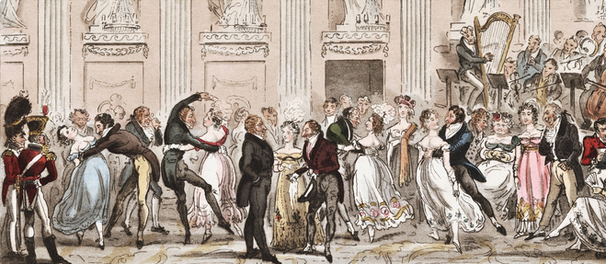
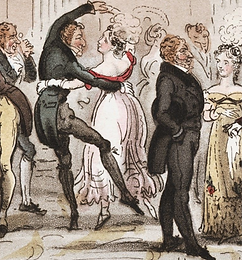
Robert Cruikshank, The Cyprian's ball at the Argyle Rooms, March 1, 1825, Lewis Walpole Library, Yale.

Hot from the hands promiscuously applied,
Round the slight waist, or down the glowing side;
Where were the rapture then to clasp the form,
From this lewd grasp, and lawless contact warm?
At once Love’s most endearing thought resign,
To press the hand so pressed by none but thine;
To gaze upon that eye which never met
Another’s ardent look without regret;

Approach the lip, which all, without restraint,
Come near enough – if not to touch – to taint;
If such thou lovest – love her then no more,
Or give – like her – caresses to a score;
Her Mind with these is gone, and with it go
The little left behind it to bestow.
Voluptuous Waltz!

Introduction of the Waltz
It is understandable that the waltz would have caused a stir in British society, and Byron's words cited above were part of his satirical critique of the dance, published in 1813. His rebuke stemmed not only from a strangely prudish and somewhat hypocritical view of how a virtuous woman should conduct herself, but also a hatred for all things German due to his strong dislike for England's Hanoverian Prince Regent.
The waltz evolved from other popular round dances of German origin, namely the Ländler. For, in the regions of southern Germany, Bavaria, Austria, and Bohemia, new couple dances in 3/4 time had emerged by the mid 18th century. These dances included the 'waltzen'. They developed among the lower classes, all requiring the man and woman to spin on a tight axis while embracing each other.

In Britain, many were first introduced to the waltz through literature. Goethe's The Sorrows of Young Werther was translated to English in 1779, and in regards to waltzing, the hero says, "I wasn't an ordinary person any more. To have the loveliest creature in my arms and to fly around with her like the weather, everything else faded into the background ..." What is more, when the Prince of Wales married Princess Caroline in 1795, they are known to have danced a waltz. Yet, British society took little notice, and it lingered in the background for years to come.
A Woman's Point of View
1812 was called "the year of the waltz" when it was first danced at Almack's, the most exclusive assembly room in Regency London. Although Lord Byron was by no means alone in his dislike for the dance, it had many proponents as well...and some of them took to defend the waltz likewise in poetic form. For example, Charlotte Nooth, a poet, took a satirical attitude towards the idea of delicate females being easily led astray or becoming physically overwhelmed by participating in a waltz. She wrote in her 1815 poem, aptly entitled "Waltz"...
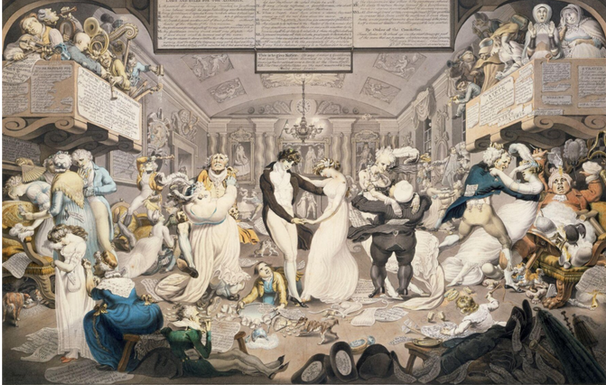
Edward Francis Burney, Waltz, Early 19th C., Victoria & Albert Museum.
FORBEAR the Waltz if in your mind
You But one spark of frailty find,
Forbear the Waltz if in your heart
One lurking devil plays his part,
Forbear the Waltz if you would shrink
From telling all you feel and think;
But if the bosom's closest fold
Might be to honour'd eyes unroll'd,
Nor blushes tinge the guilty cheek
Could Conscience find a tongue to speak,
Then ask confiding Beauty's arm,
(Who not deserving, fears no harm)
Then yield the prop by Nature meant
For woman's weaker fabric lent,
Then pace the room with agile bound,
Or whirl in rapid mazes round,
Then fearlessly the. Waltz begin,
Nor harmlessly pastime link with Sin.


Learning to Dance
In addition to the handsy nature of the dance and its innate Germanness, its origin among the lower orders of society was likewise an issue. Perhaps, this was the most dangerous aspect of the dance when it came to acceptance by the bon ton. The waltz was easy to learn and did not require the practice and lessons from dance masters that many other high society dances required. Only the most privileged would be able to acquire such skills thus it helped to define and separate classes.
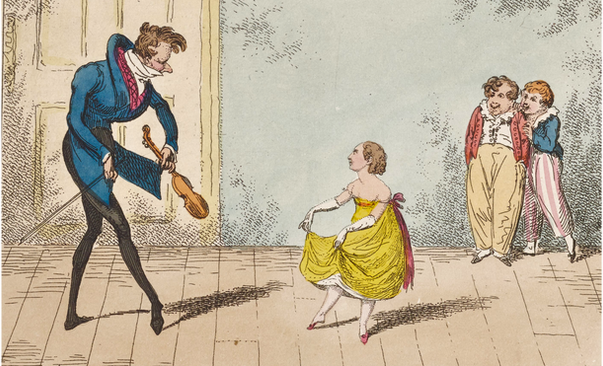
George Cruikshank, L'Ete, from The Dancing Lesson, Pt. 3, March 1, 1825, The Minnich Collection at the Minneapolis Institute of Art.
Dance manuals might supplement lessons. One such manual was Thomas Wilson's analysis of country dancing with the full title of An analysis of country dancing: wherein are displayed all the figures ever used in country dances, in a way so easy and familiar, that persons of the meanest capacity may in a short time acquire (without the aid of a master) a complete knowledge of that rational and polite amusement. To which are added, instructions for dancing some entire new reels; together with the rules, regulations, and complete etiquette of the ball room (1808). It's a long title, but at least there was no room for misunderstanding what you were buying. Other popular dances of the early 19th century included the cotillion, the quadrille, and the Scotch reel.
If there had been a dance that could be called the antithesis of the waltz, it would have been the minuet...which by the time of the rise of the waltz was nearing extinction. However, the minuet had long been the queen of dances since the court of Louis XIV. The proper comportment and intricate step patterns could take years to master. This meant developing precise control over one's body to become technically proficient. This appearance of grace was an outward manifestation of social position and authority.
In the performance of the minuet, social status determined the order of dancers. Thus, the host/hostess needed to have intimate knowledge of each guest because status depended not only on title but also on rank within a title...so age of title and family connections also had to be considered. It was a dance appropriate for large hooped skirts and large powdered wigs, but fashions change.

from James Gillray, The York-Minuet, 1791, Metropolitan Museum of Art.
Moving with the Times
Toward the end of the 18th century, the minuet began to go out of fashion and only continued to be danced occasionally as the ceremonial opening of balls. It gave way to livelier country dances (contredanses), and before long, the deviant waltz made its way into society balls. Those decades of transition saw revolutions to overthrow colonizers and monarchies, years of war with France, as well as ever-accelerating and spreading industrialization. Changes in society, almost sudden enough to be called upheavals, prefigured changes in dance.
And changes in dance always follow changes in society. Individual expression began to conquer uniformity. Social distinctions began to breakdown, and people were freed from the moors of the past and could move throughout the social ranks with more freedom than ever before. With knowledge of a just a few basic steps, anyone could step onto the dance floor on equal footing with anyone else...and eventually, the shock of such a scene wore off.

Sources:
Katz, Ruth. 1973. “The Egalitarian Waltz.” Comparative Studies in Society and History 15 (3). Cambridge, UK: Cambridge University Press: 368–77. doi:10.1017/S0010417500007155.
McKee, Eric. 2012. Decorum of the Minuet, Delirium of the Waltz : A Study of Dance-Music Relations in 3/4 Time / Eric McKee. 1st ed. Bloomington, [Indiana] ; Indiana University Press.
Bakka, Egil, ed. 2020. Waltzing through Europe : Attitudes towards Couple Dances in the Long Nineteenth Century / Edited by Egil Bakka [and Three Others]. Cambridge, England: Open Book Publishers.
Saglia, Diego. 2019. “The Years of Fame.” In Byron in Context, 23–30. Cambridge University Press. doi:10.1017/9781316850435.003.
Byron, George Gordon. Waltz: An Apostrophic Hymn, as Horace Hornem, Esq. (London: Printed by S. Gosnell for Sherwood, Neely & Jones, 1813).
Burlock, Hillary. 2021. “‘Tumbling into the Lap of Majesty’: Minuets at the Court of George III.” Journal for Eighteenth-Century Studies 44 (2). Hatfield: Wiley Subscription Services, Inc: 205–24. doi:10.1111/1754-0208.12755.
Page-Jones, Kimberley. 2021. “‘The English Can’t Waltz, Never Can, Never Will’: The Politics of Waltzing in Romantic Britain.” In British Sociability in the European Enlightenment, edited by Sebastian Domsch and Mascha Hansen, 127–46. Cham: Springer International Publishing. doi:10.1007/978-3-030-52567-5_8.
Nooth, Charlotte. 1815. “The Waltz.” In Original Poems and a Play, 4–5. London.
Childers, William. “Byron’s ‘Waltz’: The Germans and Their Georges.” Keats-Shelley Journal 18 (1969): 81–95. http://www.jstor.org/stable/30212687.
Von Goethe, Johann Wolfgang. The Sorrows of Young Werther. Oxford University Press eBooks, 2012. https://doi.org/10.1093/owc/9780199583027.001.0001.
The Library of Congress. “Baroque Dance | Western Social Dance: An Overview of the Collection | Articles and Essays | an American Ballroom Companion: Dance Instruction Manuals, Ca. 1490 to 1920 | Digital Collections | Library of Congress,” n.d. https://www.loc.gov/collections/dance-instruction-manuals-from-1490-to-1920/articles-and-essays/western-social-dance-an-overview-of-the-collection/baroque-dance/.
Wilson, Thomas, Dancing Master. An analysis of country dancing: wherein are displayed all the figures ever used in country dances, in a way so easy and familiar, that persons of the meanest capacity may in a short time acquire without the aid of a master a complete knowledge of that rational and polite amusement. To which are added, instructions for dancing some entire new reels; together with the rules, regulations, and complete etiquette of the ball room. [London, Printed by W. Calvert, to be had to Mr. Dutton et, 1808] Pdf. https://www.loc.gov/item/42049716/.
The Library of Congress. “Nineteenth Century Social Dance | Western Social Dance: An Overview of the Collection | Articles and Essays | an American Ballroom Companion: Dance Instruction Manuals, Ca. 1490 to 1920 | Digital Collections | Library of Congress,” n.d. https://www.loc.gov/collections/dance-instruction-manuals-from-1490-to-1920/articles-and-essays/western-social-dance-an-overview-of-the-collection/nineteenth-century-social-dance/.